
Remembering Gandhiji's work in Kerala
Aflatoon Posted on: 22 Feb 2010
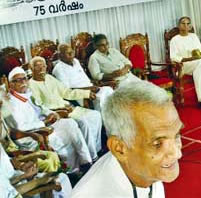
I was overwhelmed to receive this invitation from Mathrubhumi. Year-long celebration of Gandhiji's visit to Mathrubhumi office is in itself a novel way to recommit ourselves to the values on the basis of which our freedom struggle was fought alongside the fight against social injustice.
The same values shall help form an alternative to the present globalised world order. Some Satyagrahas held in India before Vaikom did not have the privilege of getting Gandhiji's guidance, as he had decided not to give any political guidance during his imprisonment . He was consulted at every step during Vaikom Satyagrah. He had sent Vinoba and Rajaji when he could not come himself.
I would like to state two small incidents.The first is related to one of Gandhiji's and Motilal Nehru's closest Kerala associates George Joseph. George Joseph edited Young India before Gandhiji took over as its editor. He edited Independent started by Motilal Nehru published from Allahabad. George Joseph spent a long time in prison with Mahadev Desai in Agra Jail in 1922.
George Joseph, wanted to start a fast on temple approachability issue after T.K. Madhavan and K.P. Keshav Menon were arrested. Gandhiji did not allow him to do so. Gandhiji felt that Hindus must provide leadership in a Satyagrah against untouchability. Leadership should emerge from the people directly affected by the problem . For the same reason he has refused the proposal by Sikhs to provide langar(community kitchen) at the Satyagrah site. I think with the same principle in mind Mayalamma successfully lead adivasis, kisans and women of Plachimada.
This battle of right against might won the world sympathy by attracting the support of leaders like Jose Bove from France , Maude Barlow and Tony Clarke from Canada, Veerendrakumarji,Medha Patkar and Vandana Shiva. Plachimada movement should also feel proud for attracting the support of Malayalam literature personalities like Prof. M. N. Vijayan , M.T. Vasudevan Nair and Sarah Joseph.Their support would always be remembered as an ideal because consumerism has not even spared the field of literature. Sahitya Akademi has started literature awards sponsored by notorious foreign multinational corporation.
The history of struggle against untouchabilty in Kerala with the inspiration of Mahatama Gandhi was given the simile of an epic by Sarojini Naidu . It was a guidance to the whole Hindu society when doors of more than two thousand temples were opened to all . Mahadev Desai wrote the history of this twelve year long struggle -The Epic of Travancore. The first part has seven chapters giving an outline of the movement.The second part describes Mahatma Gandhi's visit to Kerala during 1925 to 1937.The second part gives Gandhiji's speeches and writings during these visits.
I am quoting only a very small portion of conversation between Gandhiji and a Nambudiri Trustee : Gandhi: Will you prove to me that you are entitled to prevent them from using the roads ? I am sure that the suppressed classes have as much right to use the roads as you have.The Shastras nowhere lay down that they may not use these roads....
Nambudiri: Why,Mahatmaji,do you use the word 'suppressed' for these classes ? Do you know why they are suppressed ?
Gandhi: Oh,yes ! Just for the same reason that Dyer massacred the innocents in Jallianwala. Nambudiri: So you think those who introduced the custom were Dyers ? You would call Shankaracharya a Dyer ?
Gandhi: I am calling no Acharya a Dyer . But I do characterize your action as Dyerism, and if indeed any Acharya was responsible for introducing this custom his ignorance was as monstrous as that of General Dyer.
Gandhiji's comparison of caste-discrimination to the most cruel mass-oppression by a British officer shows his pain at the oppression of Dalits and his feelings for them. Its my earnest request to Mathrubhumi group to get The Epic of Travanacore translated into Malayalam as part of the year-long celebrations.
It is worthwhile to note that the historical dialogue between Gandhi and Dr. Ambedkar took place almost exactly in the middle of this famous struggle's twelve-year span . Historians have labeled their approaches as ' Self - Purification vs. Self Respect '. Self - purification of savarnas and raising self-respect of dalits. Both these great men were influenced by each other after having talks inside Yarvada Prison. The Epic of Travancore was unique because it promoted both self purification and self-respect simultaneously.
Constructive Work programmes were as important as Satyagraha to Gandhiji . Constructive Work provided to the world a glimpse of the alternative world .They also created the non violent force needed for Satyagrah . Satyagrahis at Vaikom informed Gandhiji that each one of them spins 1000 Yards of thread every day. (CWMG,vol.28,p.224).
Kannur is famous for its handloom and so is Varanasi . Handloom weaving provided the largest number of employment after agriculture in our country. Textile Policy has changed this scenario all together . The effect of textile policy has been three fold - the weaker section of our nation is forced to wear polyester and other synthetic cloth because it has been made cheap through subsidies. Subsidising synthetic yarn and other government measures has sent an industrialist from anonymity to the top of the capitalist heap and on the other hand handloom weavers are struggling for survival.
Hence I hope that this initiative by Mathrubhumi of year-long deliberations may bring ideas to save the handloom weavers also.
(Aflatoon is a member of the National Executive of Samajwadi Janaparishad,)
aflatoon@gmail.com
The same values shall help form an alternative to the present globalised world order. Some Satyagrahas held in India before Vaikom did not have the privilege of getting Gandhiji's guidance, as he had decided not to give any political guidance during his imprisonment . He was consulted at every step during Vaikom Satyagrah. He had sent Vinoba and Rajaji when he could not come himself.
I would like to state two small incidents.The first is related to one of Gandhiji's and Motilal Nehru's closest Kerala associates George Joseph. George Joseph edited Young India before Gandhiji took over as its editor. He edited Independent started by Motilal Nehru published from Allahabad. George Joseph spent a long time in prison with Mahadev Desai in Agra Jail in 1922.
George Joseph, wanted to start a fast on temple approachability issue after T.K. Madhavan and K.P. Keshav Menon were arrested. Gandhiji did not allow him to do so. Gandhiji felt that Hindus must provide leadership in a Satyagrah against untouchability. Leadership should emerge from the people directly affected by the problem . For the same reason he has refused the proposal by Sikhs to provide langar(community kitchen) at the Satyagrah site. I think with the same principle in mind Mayalamma successfully lead adivasis, kisans and women of Plachimada.
This battle of right against might won the world sympathy by attracting the support of leaders like Jose Bove from France , Maude Barlow and Tony Clarke from Canada, Veerendrakumarji,Medha Patkar and Vandana Shiva. Plachimada movement should also feel proud for attracting the support of Malayalam literature personalities like Prof. M. N. Vijayan , M.T. Vasudevan Nair and Sarah Joseph.Their support would always be remembered as an ideal because consumerism has not even spared the field of literature. Sahitya Akademi has started literature awards sponsored by notorious foreign multinational corporation.
The history of struggle against untouchabilty in Kerala with the inspiration of Mahatama Gandhi was given the simile of an epic by Sarojini Naidu . It was a guidance to the whole Hindu society when doors of more than two thousand temples were opened to all . Mahadev Desai wrote the history of this twelve year long struggle -The Epic of Travancore. The first part has seven chapters giving an outline of the movement.The second part describes Mahatma Gandhi's visit to Kerala during 1925 to 1937.The second part gives Gandhiji's speeches and writings during these visits.
I am quoting only a very small portion of conversation between Gandhiji and a Nambudiri Trustee : Gandhi: Will you prove to me that you are entitled to prevent them from using the roads ? I am sure that the suppressed classes have as much right to use the roads as you have.The Shastras nowhere lay down that they may not use these roads....
Nambudiri: Why,Mahatmaji,do you use the word 'suppressed' for these classes ? Do you know why they are suppressed ?
Gandhi: Oh,yes ! Just for the same reason that Dyer massacred the innocents in Jallianwala. Nambudiri: So you think those who introduced the custom were Dyers ? You would call Shankaracharya a Dyer ?
Gandhi: I am calling no Acharya a Dyer . But I do characterize your action as Dyerism, and if indeed any Acharya was responsible for introducing this custom his ignorance was as monstrous as that of General Dyer.
Gandhiji's comparison of caste-discrimination to the most cruel mass-oppression by a British officer shows his pain at the oppression of Dalits and his feelings for them. Its my earnest request to Mathrubhumi group to get The Epic of Travanacore translated into Malayalam as part of the year-long celebrations.
It is worthwhile to note that the historical dialogue between Gandhi and Dr. Ambedkar took place almost exactly in the middle of this famous struggle's twelve-year span . Historians have labeled their approaches as ' Self - Purification vs. Self Respect '. Self - purification of savarnas and raising self-respect of dalits. Both these great men were influenced by each other after having talks inside Yarvada Prison. The Epic of Travancore was unique because it promoted both self purification and self-respect simultaneously.
Constructive Work programmes were as important as Satyagraha to Gandhiji . Constructive Work provided to the world a glimpse of the alternative world .They also created the non violent force needed for Satyagrah . Satyagrahis at Vaikom informed Gandhiji that each one of them spins 1000 Yards of thread every day. (CWMG,vol.28,p.224).
Kannur is famous for its handloom and so is Varanasi . Handloom weaving provided the largest number of employment after agriculture in our country. Textile Policy has changed this scenario all together . The effect of textile policy has been three fold - the weaker section of our nation is forced to wear polyester and other synthetic cloth because it has been made cheap through subsidies. Subsidising synthetic yarn and other government measures has sent an industrialist from anonymity to the top of the capitalist heap and on the other hand handloom weavers are struggling for survival.
Hence I hope that this initiative by Mathrubhumi of year-long deliberations may bring ideas to save the handloom weavers also.
(Aflatoon is a member of the National Executive of Samajwadi Janaparishad,)
aflatoon@gmail.com


ga